
Dosage Schedule
| Cycle time | Amount per use | Frequency |
|---|---|---|
| Week 1 | 100 mcg | Once daily |
| Week 2 | 150 mcg | Once daily |
| Week 3 | 200 mcg | Once daily |
| Weeks 4–8 | 250–300 mcg | Once daily |
| Week 5 | 350–400 mcg | Once daily |
| Weeks 6–8+ | 400–500 mcg | Once daily |
Source model
Standard / Gradual Approach (3 mL = ~1.67 mg/mL)
The cited page organizes its reported range into four stages from 100 mcg to 250–300 mcg. Newt retains the mathematics so the external model can be audited.
The concentration calculation is 5 mg ÷ 3.0 mL = 1.6667 mg/mL. At that concentration, 100, 150, 200, 250 and 300 mcg correspond to approximately 0.06, 0.09, 0.12, 0.15 and 0.18 mL.
- Stage 1
The source lists 100 mcg and a calculated volume of 0.06 mL.
- Stage 2
The source lists 150 mcg and a calculated volume of 0.09 mL.
- Stage 3
The source lists 200 mcg and a calculated volume of 0.12 mL.
- Stage 4
The source lists 250–300 mcg and a calculated volume of 0.15–0.18 mL.
Anecdotal source range
Advanced / Extended Approach
The source separately labels values above 300 mcg as an advanced or extended model and notes that this range is anecdotal rather than supported by the same level of formal human study.
- 350–400 mcg source range
Mathematically equivalent to approximately 0.21–0.24 mL, or 21–24 units on a U-100 volume scale.
- 400–500 mcg source range
Mathematically equivalent to approximately 0.24–0.30 mL, or 24–30 units on a U-100 volume scale.
- Evidence limitation
The cited page itself characterizes values beyond 300 mcg as anecdotal. Newt does not endorse this range.
Reconstitution Steps
- Use a sterile syringe to draw the validated diluent volume specified by the selected vial-format table, product label or approved laboratory method.
- Inject the diluent slowly down the inside wall of the vial; avoid directing the stream onto the material and avoid foaming.
- Gently swirl or roll until fully dissolved. Do not shake.
- Label the vial with product, concentration, diluent, preparation date and operator; protect from light and refrigerate at 2–8 °C (35.6–46.4 °F) unless the product-specific method states otherwise.
- Use within the product-specific validated hold time and no later than 4 weeks after preparation unless published stability data supports a different period.
Supplies Needed
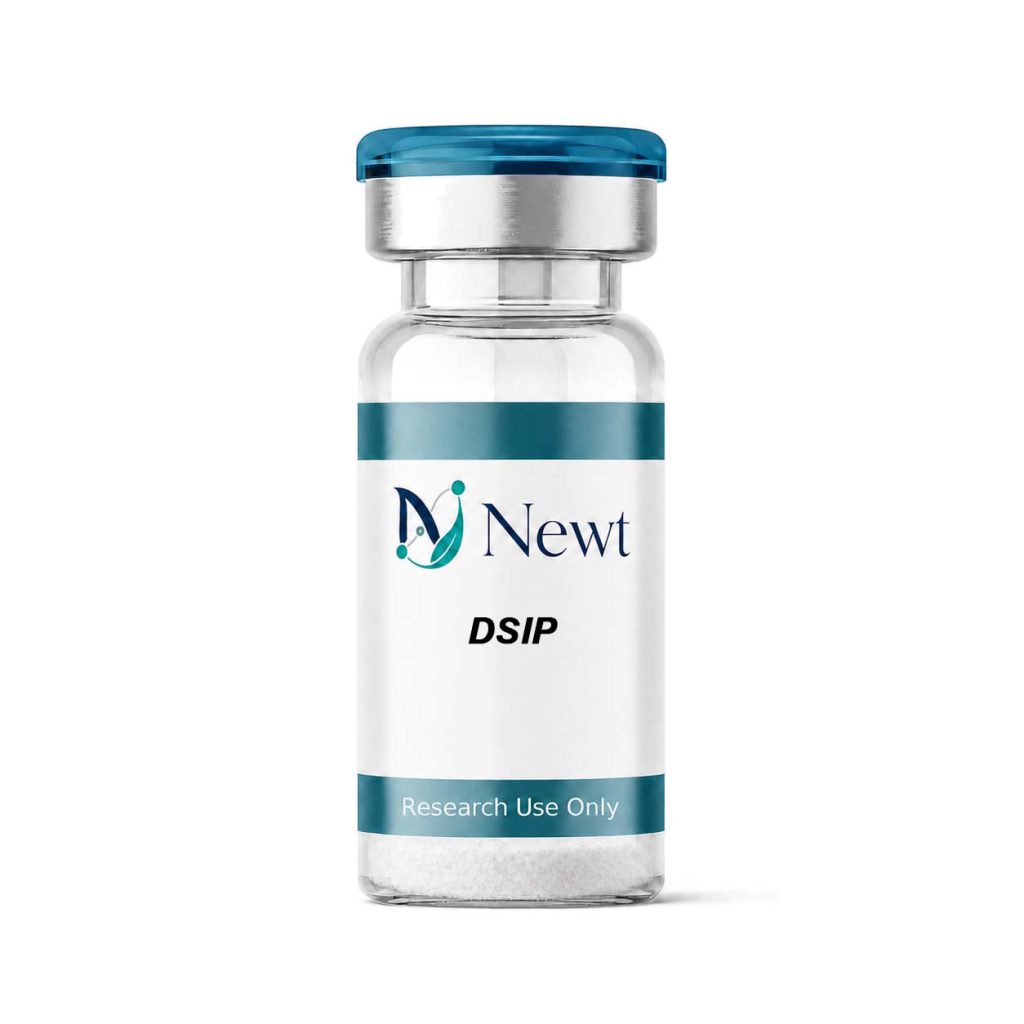
- Product vial (DSIP; use the selected labelled vial strength).
- U-100 insulin syringe (1 mL capacity) or the sterile administration device specified by the approved protocol.
- Validated diluent in the container size specified by the product label or authorized preparation method.
- Alcohol swabs and an approved sharps container—use a fresh swab for the vial stopper and each administration site.
External educational protocol
Protocol Overview
The cited source combines a 5 mg vial, a 3.0 mL final volume and a reported 100–300 mcg range, while separately discussing values up to 500 mcg.
It describes a gradual multi-week schedule and associates it with sleep-related research. These are claims from an external educational page, not an approved clinical protocol.
Newt keeps the concentration math, storage statements and evidence trail visible while separating them from product purchasing information.
Reported values
Dosing Protocol
For source fidelity, the external sequence is summarized without presenting it as an instruction for use.
- Starting source value
The source begins at 100 mcg and describes increases of roughly 50 mcg at one- to two-week intervals.
- Later source range
The source reaches 250–300 mcg in its later gradual stages.
- Time and route claim
The source associates the sequence with once-daily evening subcutaneous administration; Newt does not endorse or operationalize that claim.
- Evidence boundary
An external schedule does not establish safety, efficacy or an appropriate amount for any person.
Storage Instructions
Proper storage helps maintain product quality and stability. The supplied label, COA and product-specific validated method take precedence over these general handling rules.
- Unopened: Keep the vial sealed, dry and protected from light at the temperature stated on the supplied label; do not assume a universal shelf life.
- After preparation: Refrigerate at 2–8 °C (35.6–46.4 °F) unless the product-specific method states otherwise, and use only within its validated in-use period.
- Before opening a cold vial, allow the sealed container to equilibrate as required by the method so condensation does not enter the product.
- Long-term storage: Freeze or aliquot only when supported by product-specific stability data; avoid repeated freeze–thaw cycles and discard material with unexpected particles, discoloration or container damage.
Read before review
Important Notes
- Research use only
DSIP is presented here as an investigational research material, not a medicine or approved treatment.
- No administration instruction
This guide does not select a dose, route, schedule, injection site or treatment plan.
- Recalculate every format
The 5 mg / 3.0 mL values do not apply to another vial strength or final volume.
- Evidence is limited
The literature is small, heterogeneous and insufficient for firm clinical conclusions.
How This Works
DSIP is a nine-amino-acid peptide first characterized in the 1970s in connection with delta-electroencephalogram sleep research.
Early studies explored sleep architecture, neuroendocrine signaling and stress responses. Proposed mechanisms include effects on GABAergic, opioid and hypothalamic-pituitary-adrenal signaling, but these hypotheses remain incompletely established.
Reported effects differ across species, study designs and endpoints. Mechanistic observations do not establish a clinical indication.
Benefits & Side Effects
Benefits
- Sleep-related observations: Some older studies examined slow-wave sleep and subjective sleep measures, but findings are not uniform.
- Stress-response research: Preclinical and limited human literature has explored stress and neuroendocrine endpoints.
Side Effects & Evidence Limits
- No established benefit: The available evidence does not establish an approved therapeutic benefit or standard clinical regimen.
- Safety uncertainty: Long-term safety, interactions, contraindications and reliable adverse-event rates are not well defined.
Source context
Lifestyle Factors
The source pairs its discussion with general sleep-hygiene suggestions such as a consistent sleep schedule, a dark and quiet environment, earlier physical activity and reduced evening stimulant exposure.
These are general wellness statements and do not demonstrate that DSIP is safe or effective.
Injection Technique
Use this technique only when the product-specific approved label or authorized research protocol specifies subcutaneous administration and trained personnel are responsible for the procedure.
- Clean the vial stopper and the selected administration site with alcohol; allow both surfaces to dry completely.
- Pinch a small fold of skin and insert the needle into the subcutaneous tissue at a 45–90° angle.
- Do not aspirate during a subcutaneous injection; deliver the validated volume slowly and steadily.
- If the approved protocol specifies a volume greater than 1.0 mL, divide it between separate sites rather than using one site.
- Rotate sites systematically; commonly referenced subcutaneous sites include the abdomen, thigh and upper arm.
- Wait several seconds after delivery before withdrawing the needle to help ensure the complete validated volume is delivered.
- Discard the used syringe immediately in an approved sharps container; never recap or reuse it.
This material is provided for educational and laboratory reference only. It is not medical advice, a clinical protocol, or a recommendation for human or veterinary administration. Consult qualified professionals and applicable regulations before planning research.